Semantic Gaussian Fields
The ideas behind representing an image's meaning with a few Gaussians, built up one chapter at a time. Each chapter assumes only the chapters before it.
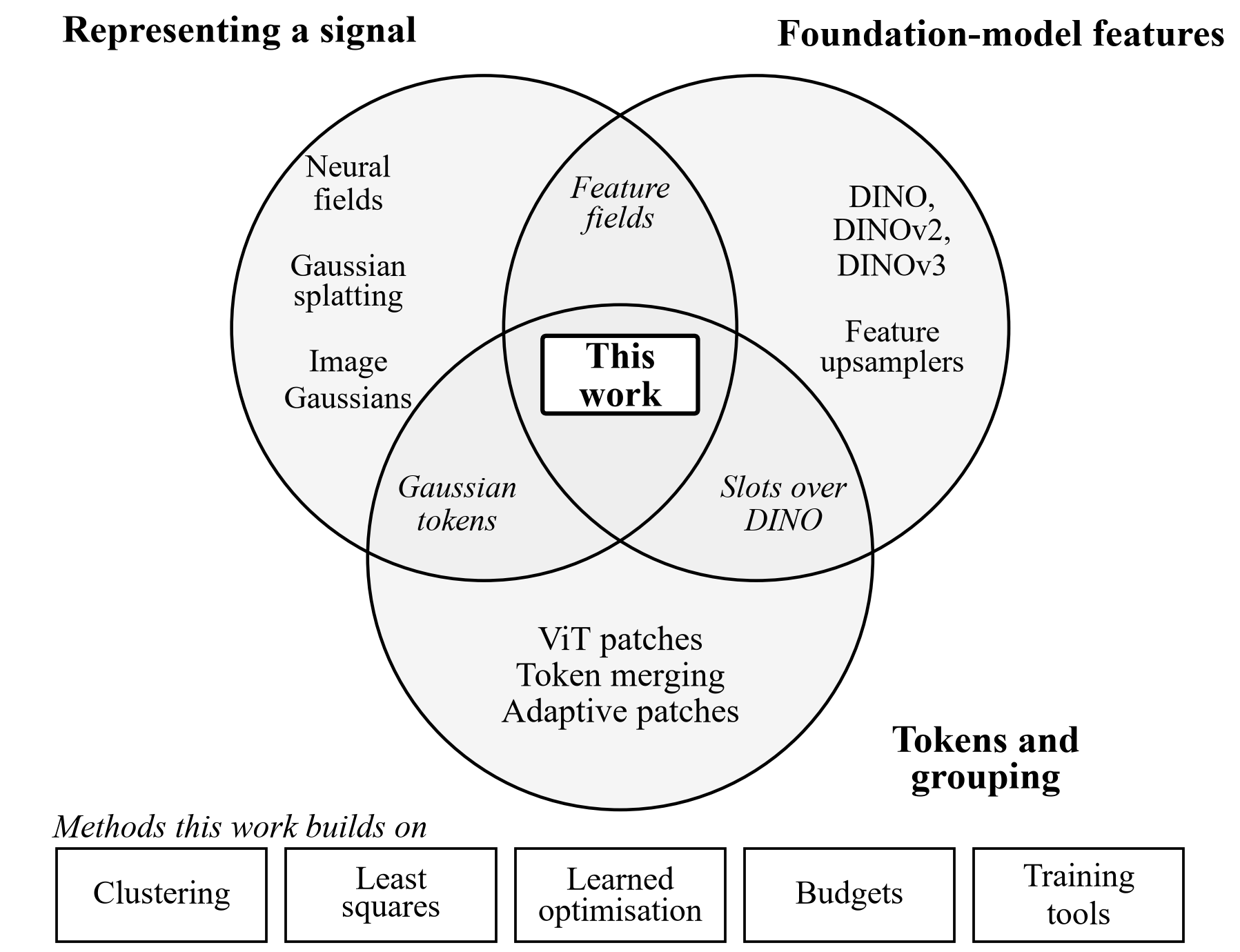
The map
Where this work sits. Circles: representing a signal (Chapters 1 to 5, 15), foundation-model features (Chapters 6 to 8, 17), tokens and grouping (Chapter 16). Overlaps: feature fields (17), Gaussian tokens (16), slots over DINO (10, 16). Boxes: clustering (9, 10), least squares (4), learned optimisation (11, 12), budgets (13), training tools (18).
Part I · Representing a signal
- Signals and how to store them
- The 2D Gaussian
- Many Gaussians: summing, compositing and sharing
- Giving each Gaussian a feature: least squares
- Putting it together: is this a neural representation?
Part II · The teacher signal
- How a vision transformer sees an image
- Self-supervised features: from DINO to DINOv3
- Resolution: why a 16×16 grid is coarse
Part III · Placing the Gaussians
Part IV · How many Gaussians?
Part V · The landscape
Part VI · Doing it properly
Appendix
Reference
- Chapter 1 summary
- Chapter 2 summary
- Chapter 3 summary
- Chapter 4 summary
- Chapter 5 summary
- Chapter 6 summary
- Chapter 7 summary
- Chapter 8 summary
- Chapter 9 summary
- Chapter 10 summary
- Chapter 11 summary
- Chapter 12 summary
- Chapter 13 summary
- Chapter 14 summary
- Chapter 15 summary
- Chapter 16 summary
- Chapter 17 summary
- Chapter 18 summary
- Chapter 19 summary
- Chapter 20 summary
- Appendix A summary
- Glossary
- Anki deck (.apkg)
To read offline: open this page once, then use the browser menu, Add to Home screen (Android: Install app).